
I'm about to share my recipe for Montreal smoked meat with y'all, and let me tell ya, this ain't your average deli sandwich meat. This journey started when my buddy Mike kept yammering on about this life-changing sandwich he had in Montreal. I was like, "Dude, it's just a sandwich," but boy was I wrong. DEAD wrong.

What Makes Montreal Smoked Meat So Dang Special
Montreal smoked meat is like pastrami's cooler Canadian cousin who went to art school and came back with an attitude. What sets it apart? Three key differences:
- The Cut: Montreal smoked meat uses the entire brisket with a generous fat cap, while pastrami often uses only the navel cut.
- The Cure: The spice profile leans heavily on coriander, black pepper, and garlic with minimal sugar (unlike pastrami's sweeter profile).
- The Technique: The crucial final steaming process creates that signature melt-in-your-mouth texture that'll make you weak in the knees.
My first attempt at making this was... let's just say my dog wouldn't even eat it. And Barney eats socks, people. SOCKS.
The Recipe Rundown – What You're Getting Yourself Into
So here's the deal – you're about to transform a massive hunk of beef into the most transcendent sandwich meat you've ever tasted. We're talking about a whole brisket covered in a symphony of spices, cured for almost two weeks, smoked low and slow, and finally steamed until it practically surrenders to gravity.
Time Investment Breakdown:
- Curing: 10-14 days
- Smoking: 6-10 hours
- Steaming: 1-2 hours
- Total active time: About 2 hours (the rest is waiting)
This ain't a weeknight recipe, folks. This is a labor of love that'll test your patience but reward you tremendously. My wife Sarah thought I was having an affair when I kept sneaking down to the basement refrigerator to "flip my meat" every day. The explanation didn't help as much as you'd think.
All About That Brisket, 'Bout That Brisket
Here's something I learned the hard way – brisket selection is CRUCIAL for authentic Montreal smoked meat. You want:
- The WHOLE brisket (both point and flat sections)
- A fat cap of at least ¼ inch
- Around 10-14 pounds of beefy glory
In Montreal delis, they offer different fat levels:
- Lean: Mostly flat section, minimal fat
- Medium: Balanced fat-to-meat ratio
- Old-fashioned/fatty: Point section, luxuriously marbled
- Speck: Extremely fatty edge pieces (for the true fat enthusiasts)
I personally go for the medium-fat option – enough fat to keep things juicy but not so much that my cardiologist puts me on speed dial.
When I served my first successful batch at our neighborhood BBQ, old man Jenkins from down the street (who hasn't said a nice word about anything since the Reagan administration) actually smiled and asked for seconds. SECONDS, people!
And when it comes to slicing, you MUST go by hand with a SHARP knife. I learned this after turning my first batch into what looked like beef confetti with an electric slicer. Slice it thin against the grain for that perfect texture – about ⅛ to ¼ inch thick is the sweet spot.
Spice Is Nice – The Flavor Foundation
The spice blend is where Montreal smoked meat really struts its stuff. Let's break down this flavor powerhouse:
The Holy Trinity:
- Coriander: The dominant flavor, providing citrusy, slightly sweet notes
- Black Pepper: For that essential warming bite and complexity
- Garlic: Providing deep, savory backbone to the profile
Supporting Cast:
- Mustard seed: Adds pungency and subtle heat
- Dill: Brings a fresh, herbal quality
- Paprika: For color and mild sweetness
- Red pepper flakes: For those who enjoy a bit more kick
My buddy Dave once tried to "improve" my recipe by doubling the red pepper flakes. His wife called me at 2 AM because he was chugging milk straight from the carton and crying. Some lessons are learned the hard way.
What makes Montreal spicing distinct from pastrami is the emphasis on coriander and garlic with minimal sugar. It's a more savory, assertive profile – like pastrami went to finishing school while Montreal smoked meat joined a rock band.
Gearing Up – Tools of the Trade
You'll need some specialized equipment for this adventure:
Essential:
- A smoker (electric, charcoal, or pellet)
- A very sharp 12-inch slicing knife
- A large container for curing
- A steamer setup (roasting pan with rack works)
Nice to Have:
- Probe thermometer with alarm
- Kitchen scale for precise measurements
- Vacuum sealer for storing leftovers
When I first started, I tried to use my gas grill as a smoker by turning on only one burner and putting wood chips in foil packets. My neighbors thought our house was on fire, and the fire department got a free lunch out of the deal. Learn from my mistakes, people.
For smokers, I've tested several options:
- Pellet smokers: Most foolproof, set-it-and-forget-it (my current preference)
- Charcoal smokers: Best flavor, but requires more attention
- Electric smokers: Most consistent temperature, traditional for Montreal delis
- Offset smokers: For the true enthusiasts with time to tend the fire
The Long Road to Flavor Town – Preparation
The journey to Montreal smoked meat nirvana happens in three distinct stages:
Stage 1: Curing (10-14 days)
This is where patience becomes your best friend. You're essentially packing that brisket in a salt-spice mixture containing:
- Kosher salt (drawing out moisture)
- Pink curing salt (preventing bacterial growth)
- The essential spice blend
The science: The salt pulls moisture from the meat through osmosis while the curing salt (sodium nitrite) prevents bacterial growth and creates that distinctive rosy color. Meanwhile, the spices slowly infuse the meat with flavor.
I keep my curing brisket in the garage fridge, which means I've had some explaining to do when Sarah's mom came to visit and wanted to store her health shakes next to what she called "that science experiment gone wrong."
Stage 2: Smoking (6-10 hours)
After rinsing off the cure and soaking the brisket to remove excess salt, you'll apply a fresh spice rub and smoke it low and slow until it reaches about 165-170°F internally.
Wood choice matters:
- Maple: Traditional Canadian choice, mild and slightly sweet
- Hickory: Stronger, bacon-like flavor
- Oak: Middle-of-the-road, reliable option
- Fruit woods: Milder flavor, good for a subtle smoke profile
Most Montreal delis use electric smokers these days because of regulations, but at home, you can go wild with whatever smoker you've got.
Stage 3: Steaming (1-2 hours)
This is the secret weapon that transforms good smoked brisket into transcendent Montreal smoked meat. Steaming to an internal temperature of 180-205°F breaks down the tough collagen in the brisket into silky gelatin.
My first steaming attempt involved a metal colander balanced precariously over a pot of boiling water. Pro tip: steam burns hurt like hell, and explaining them to the urgent care nurse is embarrassing.
A better setup: A roasting pan with a rack, an inch of water, and tight foil covering. Steam until fork-tender – you should be able to slide a fork in with almost no resistance.
The Montreal Smoked Meat Sandwich – The Ultimate Payoff
After all that work, the traditional serving method is beautifully simple:
- Hand-slice the warm meat against the grain
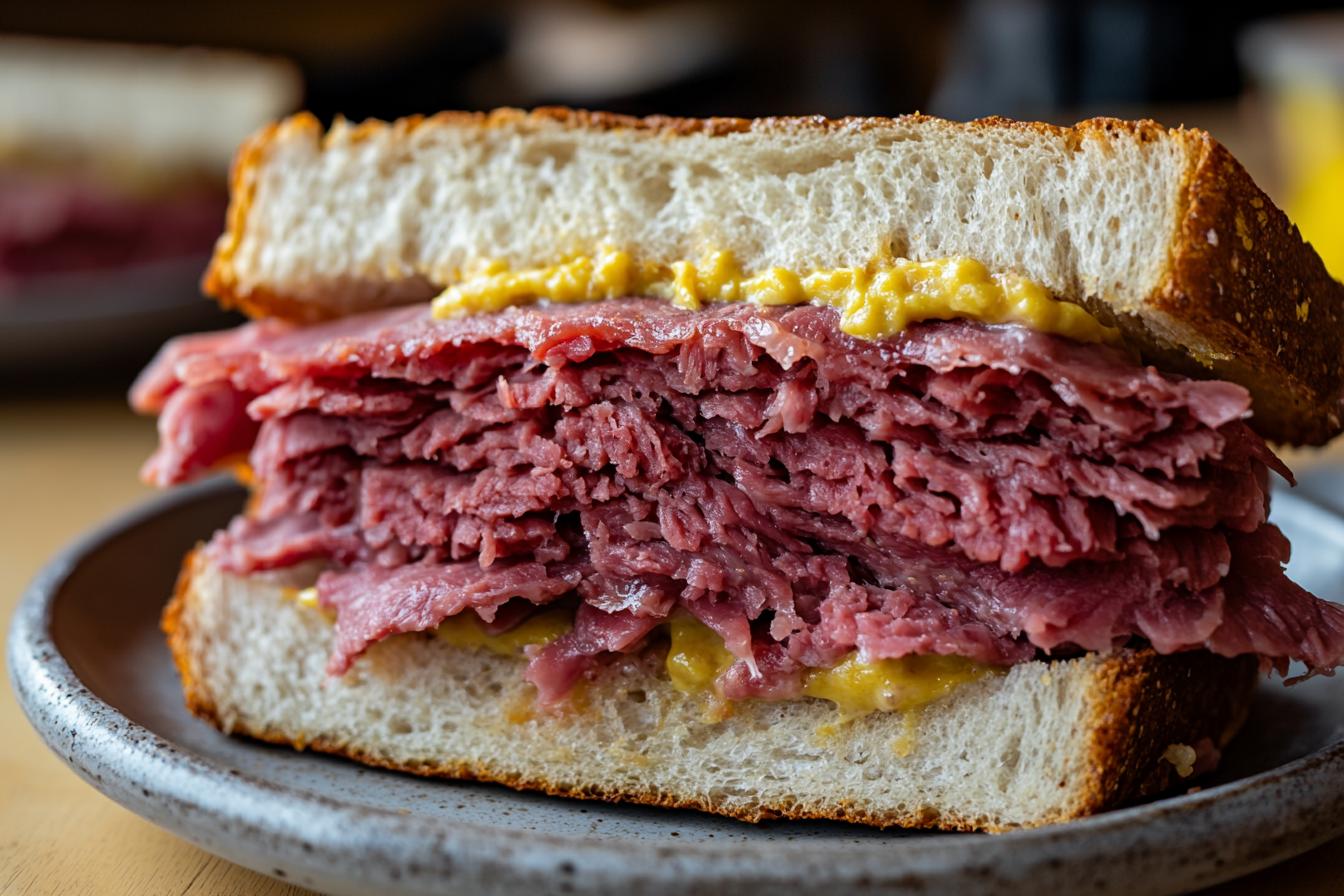
- Pile HIGH (about 6-8 oz per sandwich) on fresh rye bread
- Add a schmear of yellow mustard
- That's it!
No lettuce, no tomato, no avocado (looking at you, millennials). The meat is the star of this show.
When you've gone through all this trouble, you'll have leftovers (unless you're feeding a football team). Get creative! I've made:
- Montreal Smoked Meat Poutine: Fries, cheese curds, gravy, and chopped smoked meat (made my Canadian friend weep with joy)
- Breakfast Hash: Diced potatoes, onions, and smoked meat topped with a fried egg
- Smoked Meat Carbonara: Substitute the traditional guanciale with diced smoked meat
- Smoked Meat Reuben: The ultimate sandwich crossover event
When Things Go Sideways – Troubleshooting
Let me share my hard-earned wisdom from multiple disasters:
Problem: Too Salty
- Cause: Insufficient soaking after curing
- Solution: Soak longer next time, changing water more frequently
- Emergency Fix: If already smoked, slice thin and rinse quickly under warm water before serving
Problem: Dry Meat
- Cause: Overcooked or inadequate steaming
- Solution: Pull from smoker earlier (160-165°F) and ensure proper steaming to 180-205°F
- Emergency Fix: Slice thin and serve with au jus or gravy
Problem: Tough Meat
- Cause: Undercooked or inadequate steaming
- Solution: Steam longer until fork-tender
- Emergency Fix: Chop finely and incorporate into a different dish
Problem: Uneven Cooking
- Cause: Uneven brisket thickness or inconsistent smoker temperature
- Solution: Trim brisket for more uniform thickness or use water pan in smoker
- Emergency Fix: Separate over/undercooked portions and use accordingly
My worst batch ever happened when I got distracted by a Seinfeld marathon and forgot to check on my steaming brisket. The water evaporated, and I nearly burned down the kitchen. Sarah still brings it up during arguments that have nothing to do with cooking.
Different Strokes – Variations
You can personalize this recipe while maintaining its authenticity:
Curing Methods:
- Dry Cure (Traditional): Spices and salt applied directly to meat
- Wet Brine: Submerging in a salt-spice solution (easier but requires more space)
Smoking Variations:
- Woods: Maple (traditional), hickory (stronger), apple (milder)
- Temperature: Lower (225°F) for longer time produces more smoke flavor
- Equipment: Electric (consistent), charcoal (traditional flavor), pellet (convenient)
Finishing Methods:
- Traditional Steam: Classic method, most authentic texture
- Sous Vide After Smoking: More precise temperature control (36-48 hours at 155°F)
- Pressure Cooker: Quick method for the impatient (1 hour after smoking)
My brother-in-law Todd claims he "made dinner" after reheating leftovers. Using sous vide instead of steaming feels similar – effective but somehow like cheating. Still, I've done it when time was tight, and the results were excellent.

Overall, making Montreal smoked meat is a journey, not a destination. It's about the process, the anticipation, and finally, the payoff of biting into that perfect sandwich that you created with your own two hands (and a lot of waiting).
Everyone who tries your homemade Montreal smoked meat will be impressed. They'll think you're some kind of culinary genius. Let them think that. Don't tell them it's mostly just patience and following directions. That's our little secret.
OTHER RECIPES YOU'LL LOVE
Montreal Smoked Meat
Ingredients
- One 10-14 pound whole brisket fat cap trimmed to ¼ inch (ask your butcher if you're not sure)
- 1 cup kosher salt not table salt, unless you hate your taste buds
- 3 tablespoons ground black pepper
- 3 tablespoons ground coriander
- 1 tablespoon pink curing salt Prague powder #1 – IMPORTANT for food safety
- 1 tablespoon sugar
- 1 teaspoon ground bay leaf
- 1 teaspoon ground cloves
- 3 tablespoons coarsely ground black pepper for the rub
- 1 tablespoon ground coriander for the rub
- 1 tablespoon paprika
- 1 tablespoon garlic powder
- 1 tablespoon onion powder
- 1 teaspoon dill weed
- 1 teaspoon ground mustard
- 1 teaspoon celery seed
- 1 teaspoon crushed red pepper flakes
- Wood chunks for smoking maple or hickory recommended
Instructions
- Cure the brisket: Mix together the salt, black pepper, coriander, pink curing salt, sugar, bay leaf, and cloves in a bowl. Coat that beautiful brisket entirely with the cure and shove it in an extra-large resealable plastic bag. Stick it in the fridge and flip it once daily for 10-14 days. I use calendar reminders because I'd forget my head if it wasn't attached.
- Soak the brisket: Take the brisket out (it'll look... different) and wash off as much of the salt mixture as possible under cold water. Then soak it in cold water for 2 hours, changing the water every 30 minutes. This prevents it from being saltier than a sailor with a stubbed toe.
- Prepare the spice rub: Mix together the black pepper, coriander, paprika, garlic powder, onion powder, dill weed, mustard, celery seed, and crushed red pepper flakes. Coat the brisket with this magical mixture.
- Smoke the brisket: Fire up your smoker to 225-250°F. Add wood chunks, place the brisket fat side up, and smoke until it hits 165-170°F internally. This'll take 6-10 hours, so get comfortable. I usually pass the time by telling my family how amazing the food will be until they threaten to move out.
- Steam the brisket: Transfer the smoked brisket to a roasting pan with a rack. Add an inch of water, bring to a boil, then reduce heat, cover with foil, and steam until it reaches 180-205°F internally. This takes another 1-2 hours. Add more hot water if needed, unless you enjoy the smell of scorched pans.
- Rest and slice: Let it cool slightly, then slice AGAINST the grain as thin as possible. Serve on rye bread with mustard and prepare for praise.
Leave a Reply